

We may earn money or products from the companies mentioned in this post.
In this Big Berkey water filter review, we’ll take a closer look at how this popular stainless-steel gravity filtration system works, its capacity, filter life, contaminant-reduction claims, maintenance requirements, pros and cons, and how it compares with other water filtration options.
The Big Berkey is designed for households that want countertop drinking-water filtration without electricity or permanent plumbing modifications.
Its gravity-fed design and 2.25-gallon capacity have also made it popular among people interested in emergency preparedness, off-grid living and alternatives to smaller water-filter pitchers.
Big Berkey Water Filter Review: Quick Verdict
The Big Berkey remains an interesting option for people specifically looking for a large-capacity stainless-steel gravity water filtration system.
Its biggest advantages are simplicity, portability and the ability to operate without electricity or household water pressure.
However, prospective buyers should look beyond broad marketing claims and carefully review current contaminant-specific performance information, filter availability and the system’s limitations before purchasing.
Best for: Households wanting a large countertop gravity filter, renters, emergency-preparedness setups and people who don’t want permanent plumbing installation.
Less suitable for: People who want instant filtered water, have very limited counter space or need treatment for a specific water-quality problem without first verifying appropriate contaminant-reduction performance.
What Is the Big Berkey Water Filter?
The Big Berkey is a countertop gravity water filtration system consisting of two primary stainless-steel chambers.
Untreated water is poured into the upper chamber, where gravity pulls it through Black Berkey filter elements. The filtered water collects in the lower chamber and is dispensed through a spigot.
The system doesn’t require electricity, batteries or a connection to household plumbing.
That makes it fundamentally different from under-sink reverse osmosis systems, faucet-mounted filters and other filtration systems that rely on household water pressure.
How Does the Big Berkey Work?
The basic filtration process is straightforward:
- Fill the upper chamber with water.
- Gravity pulls the water through the Black Berkey filter elements.
- Filtered water collects in the lower stainless-steel chamber.
- Use the spigot to dispense the filtered water.
Because the system uses gravity instead of water pressure, filtration isn’t instantaneous.
Instead, the system is designed to gradually produce and store filtered water in the lower chamber.
This makes keeping the lower chamber adequately supplied more important than expecting instant filtration on demand.
Black Berkey Filter Elements
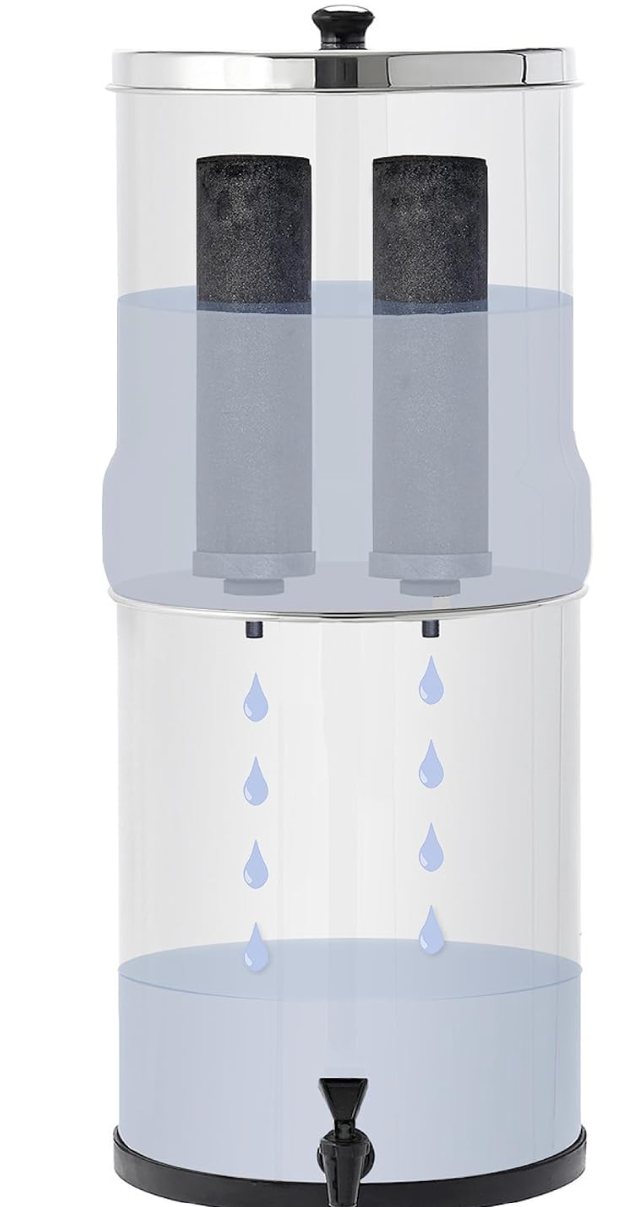
The Black Berkey Elements are the primary filtration components inside the system.
Berkey has historically published extensive contaminant-reduction claims for these elements, including testing involving numerous chemical and microbiological contaminants.
However, consumers should avoid interpreting a statement such as “reduces more than 250 contaminants” as meaning every contaminant is removed at the same percentage or under every possible water condition.
Reduction performance can vary depending on the contaminant, concentration, water chemistry, test conditions and filter usage.
If you’re purchasing a filtration system because of a specific contaminant in your water, review current contaminant-specific performance information rather than relying solely on the total number of substances tested.
Big Berkey Capacity
The Big Berkey has an approximate capacity of 2.25 gallons.
That’s considerably more than a typical refrigerator water-filter pitcher and can make the system practical for households that consume substantial amounts of drinking water.
The larger capacity comes with a trade-off: the assembled system requires dedicated counter or stand space.
Before purchasing, consider both the system’s footprint and its height, especially if you plan to place it underneath kitchen cabinets.
What Does the Big Berkey Filter?
Black Berkey Elements have been marketed and tested for reduction of numerous substances that may be found in water.
These have historically included categories such as:
- Chlorine
- Certain heavy metals
- Certain organic chemicals
- Certain microorganisms
- Sediment and particulates
- Various other substances included in Berkey’s performance testing
The important distinction is that filtration performance should be evaluated contaminant by contaminant.
A high reduction percentage reported for one substance shouldn’t automatically be applied to every other substance associated with the filter.
When you’re dealing with a known water-quality concern, testing your water first can help determine which filtration technology is appropriate.
Does the Big Berkey Remove Chlorine?
Chlorine is commonly used by municipal water utilities to disinfect drinking water.
Black Berkey Elements have historically been marketed for chlorine reduction.
Reducing residual chlorine may improve taste and odor for people who dislike chlorinated tap water.
If chlorine reduction is one of your primary reasons for considering the Big Berkey, check the current performance information for the specific filter elements you’re purchasing.
Does the Big Berkey Remove Lead?
Berkey has also published performance information involving lead reduction.
Because lead exposure can present serious health concerns, households with suspected lead contamination should consider professional water testing rather than relying on assumptions about their water supply.
If lead is detected, verify that the filtration system you’re considering has appropriate current performance data for lead reduction.
Does the Big Berkey Remove Bacteria and Parasites?
Berkey has historically published microbiological reduction testing involving certain organisms.
However, that doesn’t mean water from every lake, stream, pond or other untreated source automatically becomes safe to drink after passing through the system.
Untreated surface water can contain biological contaminants, chemicals, toxins, sewage, agricultural runoff and other hazards that vary significantly by source and location.
If you’re considering a gravity filtration system for emergency or outdoor water, follow appropriate public-health guidance and current manufacturer instructions for the type of water being treated.
Does the Big Berkey Remove Fluoride?
The standard Black Berkey Elements haven’t traditionally been the component used specifically for fluoride reduction.
Berkey has offered separate PF-2 elements designed to work with Black Berkey Elements for additional reduction of fluoride and certain other substances.
If fluoride reduction is important to you, verify current product availability, compatibility and performance documentation before purchasing additional filters.
Big Berkey Filter Life
One of the most frequently promoted benefits of Black Berkey Elements has been their long advertised service life.
A pair of Black Berkey Elements has historically been marketed with a capacity of up to approximately 6,000 gallons under specified conditions.
That number should be viewed as an advertised maximum rather than a guarantee that every household will receive exactly 6,000 gallons of optimal filtration.
Actual filter life can be influenced by:
- Incoming water quality
- Sediment levels
- Contaminant concentrations
- Household water consumption
- Filter maintenance
- Changes in filtration speed
Water containing substantial sediment or other challenging conditions may affect performance differently than relatively clean municipal tap water.
Big Berkey Flow Rate
The Big Berkey is a gravity-fed system, so water moves through the filters more slowly than it would through a pressurized under-sink filtration system.
That means some planning is required.
Rather than waiting until the lower chamber is completely empty, users can refill the upper chamber as needed so filtered water is available when they want it.
The number of installed filter elements can also affect filtration speed.
Big Berkey Spigot and Everyday Use
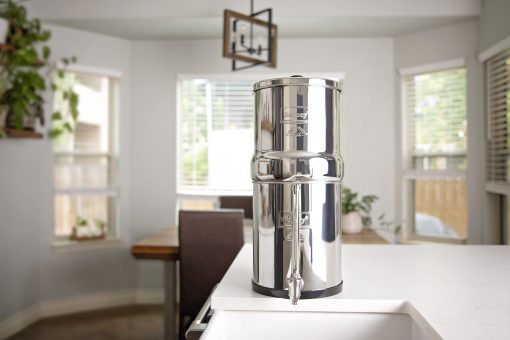
Once water has collected in the lower chamber, it’s dispensed through the spigot near the bottom of the system.
This setup makes the Big Berkey function more like a countertop water dispenser than a traditional filter pitcher.
One practical consideration is placement.
The system needs to sit high enough that you can comfortably position a glass, bottle or container underneath the spigot.
Big Berkey Setup
The Big Berkey doesn’t require permanent plumbing installation, but proper initial setup is important.
The general process involves:
- Wash the stainless-steel chambers according to the manufacturer’s instructions.
- Prepare the Black Berkey Elements according to their current instructions.
- Install the filter elements in the upper chamber.
- Seal unused filter openings with the appropriate plugs.
- Install the spigot in the lower chamber.
- Place the upper chamber on top of the lower chamber.
- Follow the manufacturer’s current flushing and preparation instructions before drinking the filtered water.
Always follow the instructions included with the specific filters and components you purchase, since preparation recommendations can change.
Big Berkey Maintenance
Although the system is mechanically simple, it still requires routine maintenance.
The stainless-steel chambers should be cleaned periodically, and special attention should be given to the lower chamber and spigot because they come into contact with already-filtered water.
The filter elements also need to be maintained according to current manufacturer instructions.
If filtration speed decreases substantially, consult the appropriate cleaning and troubleshooting instructions before assuming the filters automatically need replacement.
Does the Big Berkey Require Electricity?
No. The Big Berkey operates entirely through gravity.
There are no electrical pumps, batteries or powered components required for normal filtration.
This can make the system useful during power outages and in locations where electricity isn’t readily available.
It also means the system doesn’t depend on household water pressure.
Big Berkey for Emergency Preparedness
The lack of electricity requirements makes the Big Berkey attractive for emergency preparedness.
However, a gravity filtration system should be considered one component of an emergency-water plan rather than a substitute for stored potable water.
Floods, infrastructure failures and other emergencies can introduce unusual biological and chemical hazards into available water sources.
A filter designed to reduce certain contaminants may not address every possible emergency contaminant.
Maintaining an appropriate supply of stored drinking water and following local emergency guidance remain important.
Big Berkey vs. Alexapure Pro
The Big Berkey and Alexapure Pro share a similar overall concept.
Both use stainless-steel upper and lower chambers, operate without electricity and rely on gravity to move water through replaceable filter elements.
When comparing them, pay particular attention to:
- Current contaminant-reduction data
- Replacement-filter availability
- Replacement-filter cost
- Advertised filter capacity
- Flow rate
- System capacity
- Number of filters supported
- Current purchase price
The Big Berkey has historically advertised approximately 6,000 gallons of capacity for a pair of Black Berkey Elements, while the Alexapure Pro has marketed its filter with an advertised capacity of up to approximately 5,000 gallons.
Those figures shouldn’t be treated as a direct measure of filtration quality because filter life and contaminant-reduction performance are different specifications.
Read our Alexapure Pro review for a closer look at that system.
Big Berkey vs. Water Filter Pitcher
A traditional water-filter pitcher generally costs considerably less and occupies much less kitchen space.
However, pitchers typically have smaller reservoirs and may require frequent refilling.
The Big Berkey offers much greater capacity and can be more convenient for households that consume large amounts of filtered drinking water.
A pitcher may still be preferable if you:
- Have limited counter space
- Want refrigerated filtered water
- Have relatively low daily water consumption
- Want a lower initial purchase price
Big Berkey vs. Under-Sink Water Filter
Under-sink systems typically provide filtered water much faster because they use household water pressure.
They can also be more convenient because there’s no upper chamber to refill.
The trade-off is installation.
An under-sink system requires a plumbing connection, while the Big Berkey can simply sit on a counter or stand.
Renters and people who want portability may prefer the Big Berkey, while homeowners prioritizing convenience may prefer an under-sink system.
See our guide to affordable under-sink water filtration systems for another approach.
Big Berkey vs. Reverse Osmosis
Reverse osmosis and gravity filtration work very differently.
RO systems use a semipermeable membrane and water pressure to separate many dissolved substances from drinking water.
The Big Berkey relies on gravity and its filter media instead.
Reverse osmosis may be a better choice when water testing identifies contaminants that an appropriate RO system is specifically designed to reduce.
The Big Berkey may appeal more to people who prioritize portability, simplicity and operation without plumbing or electricity.
Neither technology should be considered universally “better.” The appropriate choice depends on your water quality and what you’re trying to remove.
Big Berkey vs. Other Gravity Water Filters
The stainless-steel housing is only one part of a gravity filtration system.
The filter element and its performance data are ultimately more important when comparing systems.
Consider:
- Contaminant-specific testing
- Certifications or independent testing
- Replacement-filter availability
- Filter lifespan
- Replacement cost
- System capacity
- Flow rate
- Ease of cleaning
- Total ownership cost
Our gravity water filtration systems guide explains the category in greater detail.
Advantages of the Big Berkey
- No electricity required
- No permanent plumbing installation
- Approximately 2.25-gallon capacity
- Durable stainless-steel chambers
- Larger capacity than most filter pitchers
- Long advertised filter life
- Portable compared with permanently installed systems
- Useful for emergency-preparedness planning
Potential Drawbacks
- Gravity filtration is relatively slow
- Requires dedicated counter or stand space
- Must be manually refilled
- Requires periodic cleaning and maintenance
- Replacement-filter cost and availability should be considered
- Broad contaminant claims require careful verification
- Doesn’t provide instant filtered water directly from a faucet
Who Should Consider a Big Berkey?
The Big Berkey may make sense for:
- Households wanting a large countertop gravity filtration system
- Renters who don’t want to modify plumbing
- People preparing for power outages or emergencies
- Homes that want filtration without electricity
- People who find water-filter pitchers too small
- People specifically interested in stainless-steel gravity systems
Who Should Consider Something Else?
You may prefer another filtration system if:
- You want instant filtered water
- You have very limited counter space
- You don’t want to manually refill a system
- You need whole-house filtration
- You need water softening
- You need treatment for a specific contaminant that isn’t adequately addressed by the filter’s current performance data
Big Berkey Pros and Cons
Pros
- Operates without electricity
- No permanent plumbing modifications
- Large capacity compared with pitchers
- Stainless-steel construction
- Long advertised filter capacity
- Simple gravity-fed operation
- Useful for emergency preparedness
Cons
- Slower than pressurized filtration
- Requires counter or stand space
- Needs manual refilling
- Requires routine maintenance
- Replacement filters create ongoing expense
- Contaminant claims need to be evaluated individually
Frequently Asked Questions
How long do Black Berkey Elements last?
A pair of Black Berkey Elements has historically been advertised for up to approximately 6,000 gallons under specified conditions. Actual useful filter life can vary based on water quality, usage and maintenance.
How much water does the Big Berkey hold?
The Big Berkey has an approximate capacity of 2.25 gallons, making it significantly larger than most water-filter pitchers.
Does the Big Berkey need electricity?
No. Water moves through the filter elements using gravity, so normal operation doesn’t require electricity or batteries.
Does the Big Berkey remove fluoride?
The standard Black Berkey Elements haven’t traditionally been the system’s dedicated fluoride-reduction component. Berkey has offered separate PF-2 filters for additional fluoride reduction. Check current compatibility, availability and performance information before purchasing.
Can you use a Big Berkey with well water?
That depends on what’s in the well water. Private wells can contain microorganisms, minerals, metals, agricultural contaminants and other substances that vary by location. Test the well water first and select treatment based on the results rather than assuming one filtration system can address every possible problem.
Can the Big Berkey make stream water safe to drink?
You shouldn’t assume that unknown surface water automatically becomes safe simply because it has passed through a gravity filter. Streams and lakes can contain biological and chemical hazards that require appropriate treatment based on the conditions and source.
Is the Big Berkey better than reverse osmosis?
Neither technology is universally better. Reverse osmosis can be highly effective for certain dissolved contaminants, while the Big Berkey offers portability and gravity operation without permanent plumbing. The better choice depends on your water-quality problem and priorities.
Is the Big Berkey worth it?
The Big Berkey may be worth considering if you specifically want a large-capacity stainless-steel gravity filtration system and value operation without electricity or plumbing. If convenience, instant filtration or limited counter space are bigger priorities, another filtration system may be a better fit.
Final Verdict: Big Berkey Water Filter Review
Our Big Berkey water filter review finds that the system’s strongest features are its simplicity, stainless-steel construction, 2.25-gallon capacity and ability to operate entirely through gravity.
For renters, emergency-preparedness households and people who want more capacity than a traditional water-filter pitcher, those characteristics can make it an appealing filtration system.
At the same time, buyers shouldn’t rely solely on broad claims about hundreds of contaminants. Water filtration performance should be evaluated against the specific contaminants you’re concerned about and the current testing available for the filter elements.
If you have a known water-quality problem, start with appropriate water testing and choose filtration technology that has suitable performance data for that problem.
If your priority is a large-capacity gravity system that doesn’t require electricity or plumbing, the Big Berkey remains a product worth comparing with alternatives such as the Alexapure Pro.