

We may earn money or products from the companies mentioned in this post.
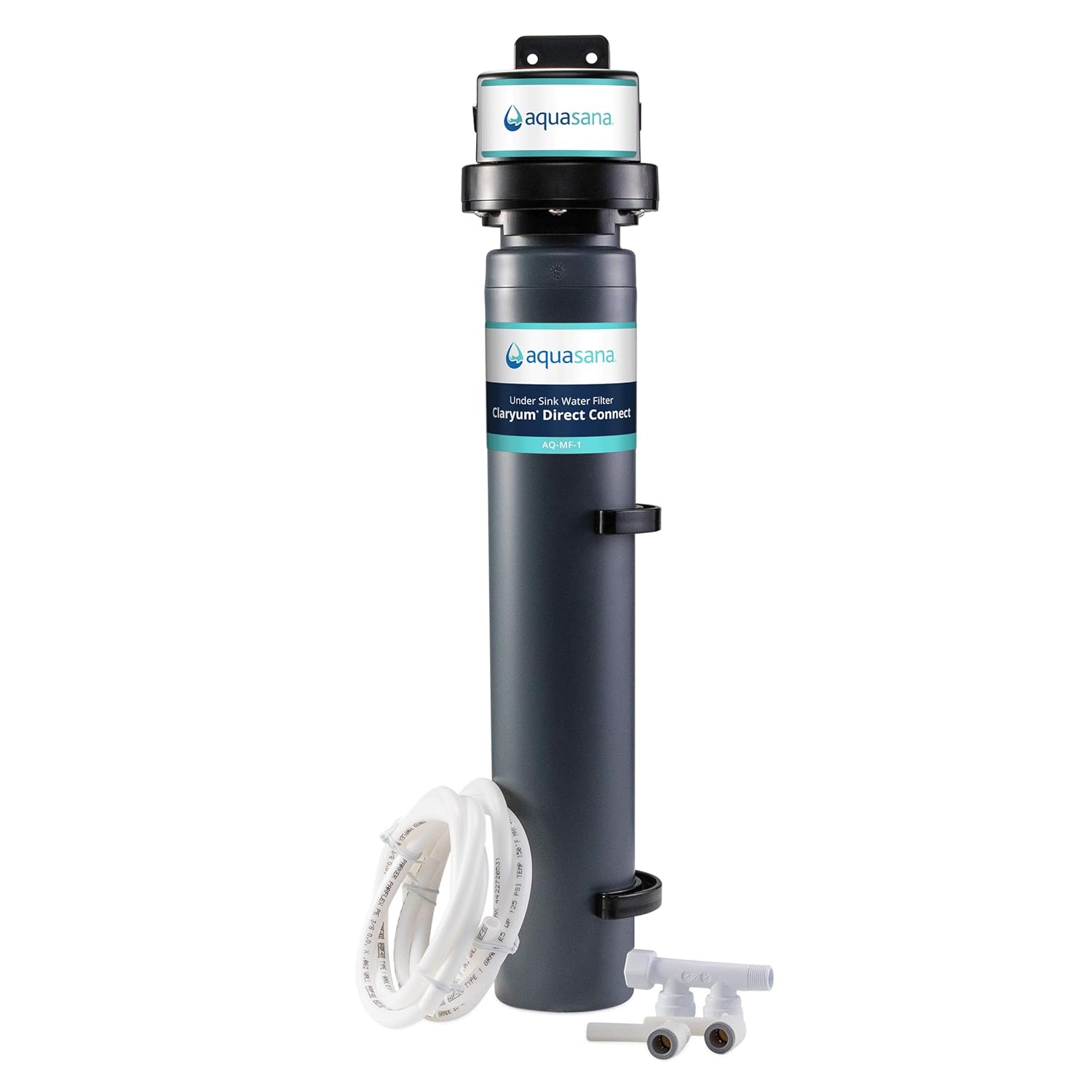
Aquasana Claryum Direct Connect review: The Aquasana Claryum Direct Connect is an under-sink water filter designed for people who want filtered water directly from their existing kitchen faucet without installing a separate drinking-water faucet or reverse osmosis system.
Its direct-connect design makes it particularly appealing for homeowners and renters who want to improve their drinking and cooking water while keeping their kitchen sink looking the same. But how well does it filter water, how difficult is installation, and is it worth the ongoing replacement-filter cost?
In this review, we’ll examine how the Aquasana Claryum Direct Connect works, filtration performance, certifications, filter life, installation, maintenance, advantages, limitations, and how it compares with other under-sink filtration options.
Check the Aquasana Claryum Direct Connect on Amazon
Aquasana Claryum Direct Connect Review: Quick Verdict
The Aquasana Claryum Direct Connect is a strong option for households that want substantial under-sink filtration without adding a dedicated filtered-water faucet.
Instead, the system connects directly to the cold-water line beneath the sink and sends filtered cold water through the existing kitchen faucet.
Best for: Households wanting convenient under-sink filtration through their existing faucet without the storage tank and additional components associated with reverse osmosis.
Less suitable for: Homes needing water softening, substantial dissolved-solids reduction, whole-house filtration, or treatment of microbiologically unsafe source water.
What Is the Aquasana Claryum Direct Connect?
The Aquasana Claryum Direct Connect is a point-of-use water filtration system installed beneath a kitchen sink.
Unlike systems that require a second faucet specifically for filtered drinking water, the Direct Connect configuration connects to the existing cold-water supply and filters the cold water delivered through the kitchen faucet.
This creates a relatively streamlined installation while giving you filtered water for drinking, filling reusable bottles, preparing coffee and tea, and cooking.
It also means the filter may process more water than a dedicated-faucet system because normal cold-water use at the kitchen sink passes through the filtration system.
How Does the Aquasana Claryum Direct Connect Work?
The system is installed between the kitchen’s cold-water supply and the existing faucet.
The basic process works like this:
- Cold water enters from the household supply line.
- Water is directed through the Claryum filtration cartridge.
- The filter media targets specific contaminants according to the system’s performance specifications.
- Filtered cold water continues to the existing kitchen faucet.
- Hot water continues to operate separately through the normal hot-water line.
There is no reverse osmosis storage tank and no separate filtered-water faucet required for the standard Direct Connect configuration.
What Is Claryum Filtration?
Claryum is Aquasana’s multi-stage filtration technology.
Rather than relying on only one type of filter media, the system combines filtration technologies intended to address different categories of contaminants.
Depending on the particular Claryum product and its current specifications, these technologies can include activated carbon, catalytic carbon, ion-exchange media and mechanical filtration.
The important distinction is that this is a filter, not a reverse osmosis membrane.
It is designed to selectively reduce specified contaminants rather than broadly remove most dissolved substances from the water.
What Does the Aquasana Claryum Direct Connect Remove?
Aquasana has marketed the Claryum Direct Connect for reduction of numerous contaminants, including categories involving chlorine, lead and certain organic chemicals.
However, contaminant claims should always be tied to the current performance data for the exact system rather than assuming that every Aquasana or Claryum product has identical capabilities.
Depending on the current certification and performance specifications, contaminant-reduction categories may include:
- Chlorine taste and odor
- Lead
- Certain volatile organic compounds
- Certain pesticides and herbicides
- Particulates
- Certain pharmaceuticals and emerging contaminants
- Other specifically tested contaminants
Before purchasing any water filter for a known contamination problem, compare your water-quality concerns with the current performance data for the exact model.
Does It Remove Chlorine?
Chlorine reduction is one of the primary reasons many households install an activated-carbon-based under-sink filter.
Reducing chlorine can improve the taste and odor of municipally treated drinking water, particularly for people who notice a strong chlorine characteristic from their tap.
The Claryum filtration design incorporates carbon-based filtration as part of its treatment process.
Does the Aquasana Claryum Direct Connect Remove Lead?
Lead reduction is one of the more important performance considerations when evaluating an under-sink drinking-water filter.
The Claryum Direct Connect has been marketed with lead-reduction capabilities, but consumers concerned about lead should verify the current certification and performance sheet for the exact model before relying on it for treatment.
Lead can’t be reliably identified by taste, smell or appearance. If you have reason to suspect lead in your drinking water, appropriate water testing is an important first step.
Does It Remove PFAS?
Aquasana has published contaminant-reduction information for certain Claryum systems involving compounds within the broad PFAS category, historically including PFOA and PFOS claims on applicable products.
Because PFAS standards, testing methods and product certifications continue to evolve, check the current performance data for the exact Direct Connect model if PFAS reduction is one of your main reasons for buying the system.
Does It Remove Microplastics?
Mechanical filtration can capture particles above the filter’s effective pore or particle-retention range, but “microplastics” covers particles of many different sizes.
Rather than assuming universal microplastic removal, check the manufacturer’s current performance claims if this contaminant category is a priority.
Does Aquasana Claryum Remove Fluoride?
The Claryum Direct Connect shouldn’t automatically be expected to substantially remove dissolved fluoride.
Fluoride behaves differently from contaminants that are readily captured by activated carbon.
If fluoride reduction is specifically important to you, choose a filtration technology with appropriate fluoride-specific performance data.
Does It Reduce Water Hardness?
No. The Aquasana Claryum Direct Connect isn’t a traditional water softener.
It shouldn’t be expected to substantially remove the calcium and magnesium responsible for hard water or prevent scale throughout your plumbing system.
If hardness is your primary concern, read our guide to choosing a water filter for hard water.
Does It Remove Healthy Minerals?
One reason some consumers prefer carbon-based filtration over reverse osmosis is that these systems don’t generally remove dissolved minerals to the same degree as an RO membrane.
Minerals such as calcium and magnesium can therefore remain in the water.
That shouldn’t be interpreted to mean the system somehow identifies “good” minerals and intentionally preserves them while identifying everything undesirable. It simply uses a different filtration mechanism from reverse osmosis.
Our guide explaining what happens to minerals during water treatment provides additional context on calcium and magnesium in household water.
Aquasana Claryum Direct Connect Certifications
Certification is one of the most important considerations when comparing drinking-water filters.
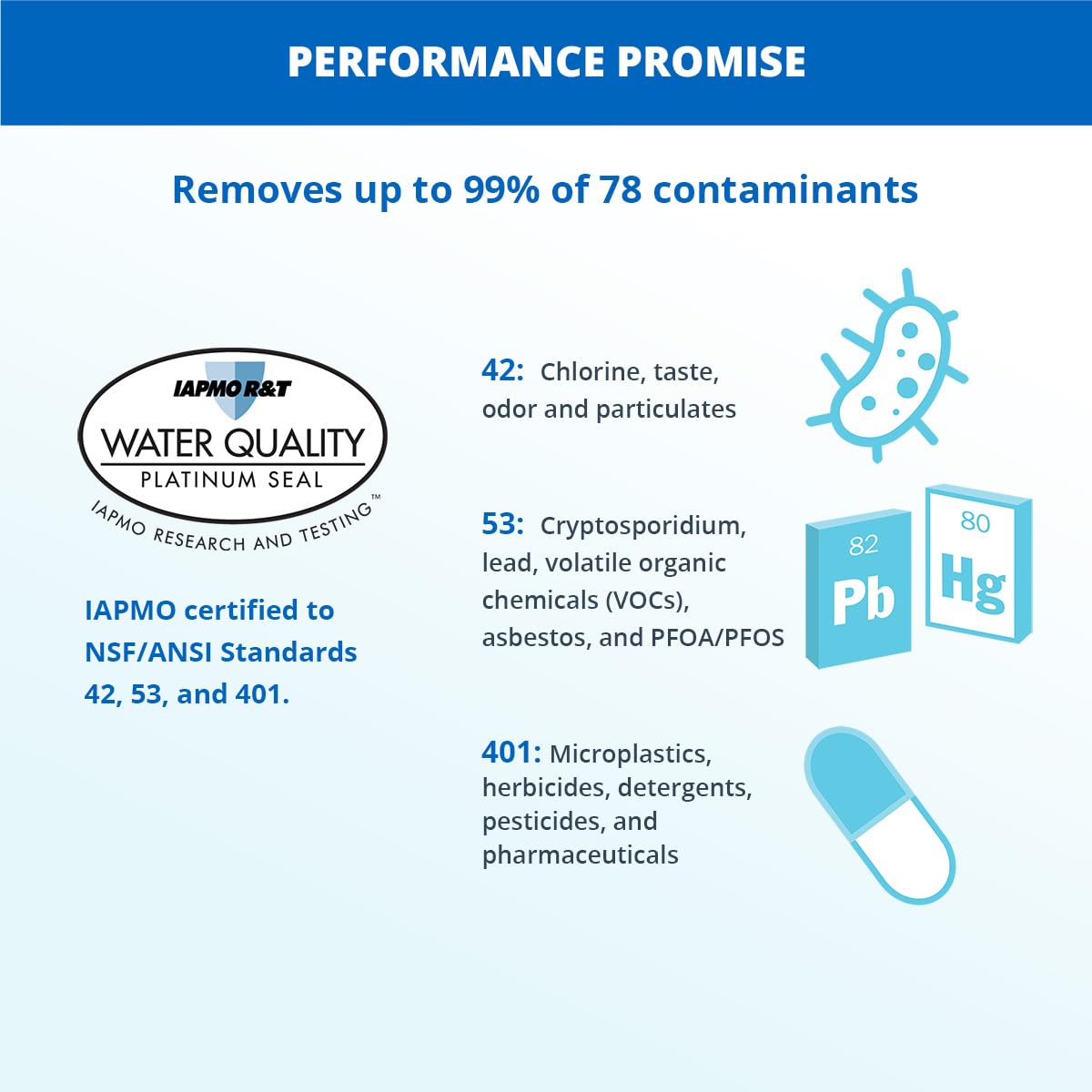
The original version of this review referenced NSF/ANSI Standards 42, 53 and 401 in connection with the Claryum Direct Connect.
NSF/ANSI 42 generally covers aesthetic effects such as chlorine taste and odor and certain particulate claims.
NSF/ANSI 53 addresses specific health-related contaminant-reduction claims.
NSF/ANSI 401 covers reduction claims involving certain emerging or incidental contaminants.
A certification to one of these standards does not mean a filter removes every contaminant associated with the standard. Certification applies to the specific claims for which the particular product has been evaluated.
For more information about what these standards mean, see NSF’s guide to drinking-water treatment standards.
Aquasana Claryum Direct Connect Performance
Performance should be evaluated based on more than the total number of contaminants advertised.
When comparing this system with another filter, look at the contaminants that actually matter for your water supply.
For example, a household concerned primarily about chlorine taste may have very different filtration needs from one dealing with a confirmed lead problem.
The strongest buying decision comes from matching verified water-quality concerns with independently tested product performance.
Aquasana Claryum Direct Connect Installation
One of the main attractions of this system is its relatively straightforward direct-connect installation.
A typical installation involves:
- Turning off the cold-water supply beneath the sink.
- Disconnecting the existing cold-water connection.
- Connecting the filtration system according to Aquasana’s instructions.
- Mounting the filter assembly beneath the sink.
- Connecting the outlet to the existing faucet’s cold-water line.
- Turning the water supply back on.
- Checking every connection carefully for leaks.
- Flushing the new filter according to the manufacturer’s instructions.
The exact installation procedure can vary with plumbing configuration, so use the instructions supplied with the current system rather than relying solely on a general installation guide.
Do You Need a Separate Faucet?
No separate filtered-water faucet is one of the biggest differences between the Claryum Direct Connect and many traditional under-sink systems.
The system filters cold water delivered through your existing kitchen faucet.
This can be particularly helpful if you don’t want to drill another hole in the sink or countertop.
It also creates a cleaner-looking installation because there isn’t an additional faucet beside the main kitchen fixture.
How Long Does Installation Take?
Aquasana has promoted the Direct Connect as a relatively quick DIY installation, and households with compatible plumbing may be able to complete installation without hiring a plumber.
However, claims such as “30-minute installation” should be treated as an estimate rather than a guarantee.
Your installation time depends on accessibility, plumbing configuration, available space, existing fittings and your comfort working with plumbing connections.
Filter Life and Replacement
Like every cartridge-based filtration system, the Claryum Direct Connect requires periodic filter replacement.
Don’t judge filter life solely by a calendar estimate.
Actual service life can be affected by:
- Household water consumption
- Incoming water quality
- Sediment levels
- Contaminant concentrations
- Changes in flow
- Manufacturer capacity recommendations
Follow the current replacement schedule and rated capacity specified by Aquasana for the exact cartridge you’re using.
What Does It Cost to Maintain?
The initial purchase price isn’t the only cost to consider with an under-sink filtration system.
Replacement cartridges are the main recurring expense.
Before buying, check:
- Current replacement-filter price
- Rated filter capacity
- Recommended replacement interval
- Availability of replacement cartridges
- Estimated annual filter cost for your household
A lower-priced filtration system isn’t necessarily less expensive over several years if its replacement filters are costly or require frequent changes.
Aquasana Claryum Direct Connect vs. Culligan EZ Change
Both systems provide under-sink drinking-water filtration, but their designs differ.
The Aquasana Direct Connect’s main convenience is that it filters cold water through the existing kitchen faucet.
The Culligan EZ Change configuration we reviewed typically uses a dedicated filtered-water faucet, which means only water intentionally drawn from that faucet consumes filter capacity.
The better design depends on what you value more: having all cold kitchen water filtered automatically or preserving filter capacity by using a separate drinking-water faucet.
Read our Culligan EZ Change review for a closer look at that system.
Aquasana Claryum Direct Connect vs. Reverse Osmosis
The Claryum Direct Connect isn’t a reverse osmosis system, and that creates meaningful differences.
Advantages of the Aquasana
- No RO storage tank
- No separate faucet in the Direct Connect configuration
- No RO reject-water stream during normal filtration
- Retains more dissolved minerals than typical RO treatment
- Simpler overall system
Advantages of Reverse Osmosis
- Can reduce a broader range of dissolved substances
- Significantly reduces total dissolved solids
- May be better suited to certain dissolved-contaminant concerns
Neither approach is automatically better. The correct choice depends on your water quality and treatment goals.
Aquasana Claryum Direct Connect vs. Filter Pitcher
A filter pitcher wins on simplicity. There’s no plumbing installation, and the initial cost is usually lower.
The Direct Connect system wins on convenience because filtered cold water is available directly from the kitchen faucet without repeatedly filling a pitcher.
For households that consume substantial amounts of filtered water for drinking and cooking, under-sink filtration can be considerably more convenient.
Advantages of the Aquasana Claryum Direct Connect
- Uses the existing kitchen faucet
- No separate drinking-water faucet required
- No reverse osmosis storage tank
- Multi-stage filtration technology
- Designed to reduce multiple categories of contaminants
- Carbon-based filtration can improve chlorine taste and odor
- Doesn’t remove dissolved minerals to the same degree as RO
- Compact under-sink installation
- Filtered water available for drinking and cooking
Potential Drawbacks
- Requires installation beneath the sink
- Replacement filters create an ongoing expense
- All cold water from the kitchen faucet can consume filter capacity
- Doesn’t soften hard water
- Doesn’t provide the same dissolved-solids reduction as reverse osmosis
- Not intended as a universal treatment solution for microbiologically unsafe water
- Compatibility depends on the existing plumbing configuration
Who Should Consider the Aquasana Claryum Direct Connect?
This system may be a particularly good fit if you:
- Want filtered water directly from your kitchen faucet
- Don’t want to install a separate drinking-water faucet
- Want something simpler than reverse osmosis
- Want to reduce chlorine taste and odor
- Have contaminant concerns addressed by the system’s current performance specifications
- Use filtered water frequently for drinking and cooking
- Have adequate space beneath the kitchen sink
Who Should Consider Another System?
You may need another treatment approach if:
- You need whole-house filtration
- Your main problem is hard water
- You specifically want substantial TDS reduction
- Your water contains contaminants outside the filter’s verified capabilities
- Your source water is microbiologically unsafe
- You want a dedicated filtered-water faucet to conserve filter capacity
Pros and Cons
Pros
- Convenient direct-connect design
- Uses the existing kitchen faucet
- No separate faucet required
- Multi-stage filtration
- Compact compared with many RO systems
- No storage tank
- Good option for everyday drinking and cooking water
Cons
- Ongoing replacement-filter costs
- Requires under-sink plumbing connections
- Not a water softener
- Not equivalent to reverse osmosis
- Cold-water usage can consume filter capacity faster than a dedicated-faucet design
Is the Aquasana Claryum Direct Connect Worth It?
For households that want convenient under-sink filtration without adding another faucet, the Claryum Direct Connect has a compelling design.
Its strongest feature is simplicity: once installed, filtered cold water comes directly from the existing kitchen faucet.
That convenience needs to be weighed against replacement-filter costs and the fact that all cold-water use at that faucet can contribute to filter usage.
As with any water filter, the deciding factor should be whether its verified contaminant-reduction capabilities match the problems present in your water.
For more options, see our guide to affordable under-sink water filtration systems.
Frequently Asked Questions
Does the Aquasana Claryum Direct Connect need a separate faucet?
No. The Direct Connect configuration is designed to supply filtered cold water through your existing kitchen faucet.
Is Aquasana Claryum Direct Connect reverse osmosis?
No. It uses multi-stage filtration rather than a reverse osmosis membrane and doesn’t reduce dissolved solids in the same way an RO system does.
Does Aquasana Claryum Direct Connect remove lead?
The system has been marketed with lead-reduction performance. If lead is your primary concern, verify the current certification and performance data for the exact model before purchase.
Does Aquasana Claryum Direct Connect remove chlorine?
Its carbon-based filtration is designed to address chlorine taste and odor among its filtration functions.
Does Aquasana Claryum Direct Connect remove fluoride?
Don’t assume substantial fluoride reduction from this type of filtration. If fluoride is a specific concern, choose a system with verified fluoride-reduction performance.
Does Aquasana Claryum Direct Connect soften water?
No. It isn’t a conventional ion-exchange water softener and shouldn’t be expected to remove household hardness caused by calcium and magnesium.
Does it remove beneficial minerals?
It doesn’t reduce dissolved minerals to the same degree as reverse osmosis, so minerals such as calcium and magnesium generally remain in the water.
Can I install it myself?
Many homeowners with compatible plumbing may be able to install the system themselves using basic tools. Installation difficulty depends on the existing plumbing and available under-sink space.
How often should the filter be replaced?
Follow Aquasana’s current replacement interval and capacity recommendation for your specific filter. Actual service life can also depend on household usage and incoming water quality.
Is the Aquasana Claryum Direct Connect worth buying?
It can be a strong choice if you want multi-stage under-sink filtration through your existing kitchen faucet and its verified contaminant-reduction capabilities match your water-quality needs.
Final Verdict: Aquasana Claryum Direct Connect Review
Our Aquasana Claryum Direct Connect review finds that its greatest advantage is convenience. It provides filtered cold water through the existing kitchen faucet without requiring a second faucet, storage tank or reverse osmosis setup.
Its multi-stage Claryum filtration also makes it a more capable option than basic taste-and-odor filters when its certified contaminant reductions match your needs.
It’s not the answer to every water-quality problem. It won’t replace a water softener, and consumers seeking broad dissolved-solids reduction may prefer reverse osmosis.
But for households looking for convenient point-of-use filtration without dramatically changing their kitchen setup, the Aquasana Claryum Direct Connect is a strong option to consider.